The Constitution is a framework for how government operates. Who has power? Over whom? To do what? But the how of government cannot be fully understood apart from the why, and honoring or supporting it depends on understanding both together.
The Constitution and the Declaration Are a Package Deal
The Declaration of Independence is the foundation of our social contract. It is what broke us away from the British government and declared our Independence. The Constitution is the structure built on it. Separate them, and you’ve pulled the "why" out from under the "how."
The Declaration tells us where government power comes from: the consent of the governed. It tells us what government is for: securing the rights that belong to people by nature, not by the government’s permission. These aren’t vague sentiments — they’re the premises on which the entire constitutional project rests.
A government that treats the Constitution as merely flexible or procedural has already quietly discarded the Declaration’s claim that authority has limits and a source. Fidelity to the Constitution, rightly understood, is fidelity to that foundation.
The Words Matter
Think of it this way. Suppose you buy an appliance with a 2-year warranty and have a problem at 2 years and 5 days. Those five days could cost you thousands of dollars. The terms of the contract are the standard your claim is judged against.
You could argue the cutoff was somewhat arbitrary — it could have been drawn slightly differently. Maybe. But that doesn’t mean you get to change the terms after the fact. You agreed to the contract. The terms are the terms.
The Constitution is the contract our founders agreed to, built on the foundation of the Declaration. We can change it — the amendment process exists precisely for that. But we cannot simply ignore its terms because we find them inconvenient. Fidelity matters because contracts only function when the parties are bound by them.
The Consent Threshold
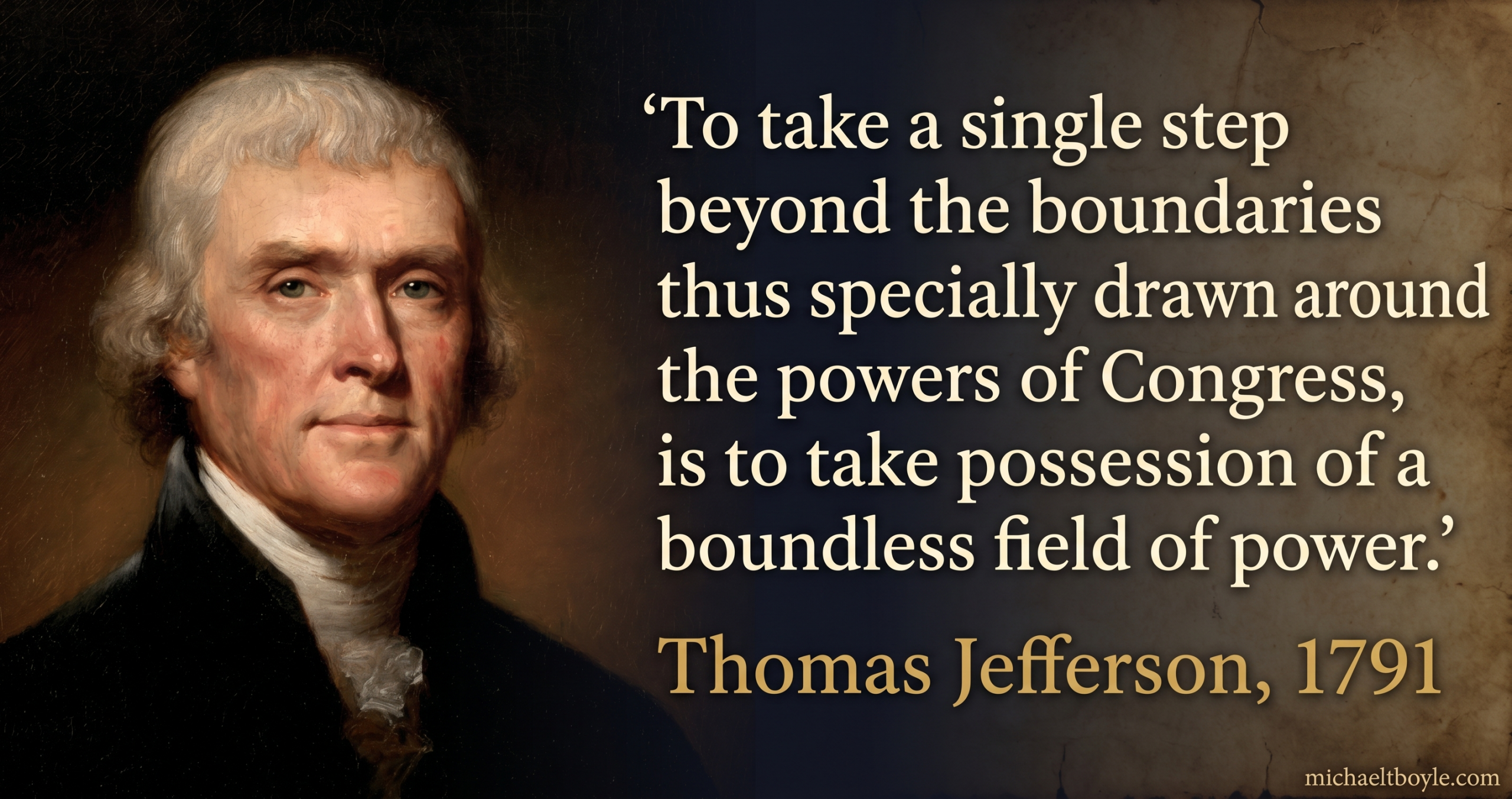
Thomas Jefferson put it plainly in 1791:
“To take a single step beyond the boundaries thus specially drawn around the powers of Congress, is to take possession of a boundless field of power, no longer susceptible of any definition.”
The Declaration says government power derives from the consent of the governed. The Constitution defines the scope of that consent in specific, structural terms. The moment a government steps beyond what the people have consented to, it crosses a line — not a procedural one, but a moral one.
On one side of that line is government by principle. On the other is government by might makes right.
That is why fidelity to the Constitution is not a technicality. It is the difference between a government that serves the people and one that has simply decided it knows better.
If this resonated with you, share it with someone who needs to hear it. And leave a comment below — I’d love to hear your thoughts.