Through faith in Christ, every believer can live with a clean conscience, be part of a redeemed family, and live in proper submission to the state.
Most Christians understand that salvation changes the individual. What fewer realize is that Christ’s lordship doesn’t stop at the soul — it extends to every institution God has ordained for human flourishing. When those institutions are ordered under God, blessing flows. When they aren’t, suffering follows.
This is what I call the Four-Fold Blessing: the fullness of what God intends when Christ is Lord of every sphere of life — individual conscience, family, church, and civil government. It is the framework behind everything I teach, preach, and do.
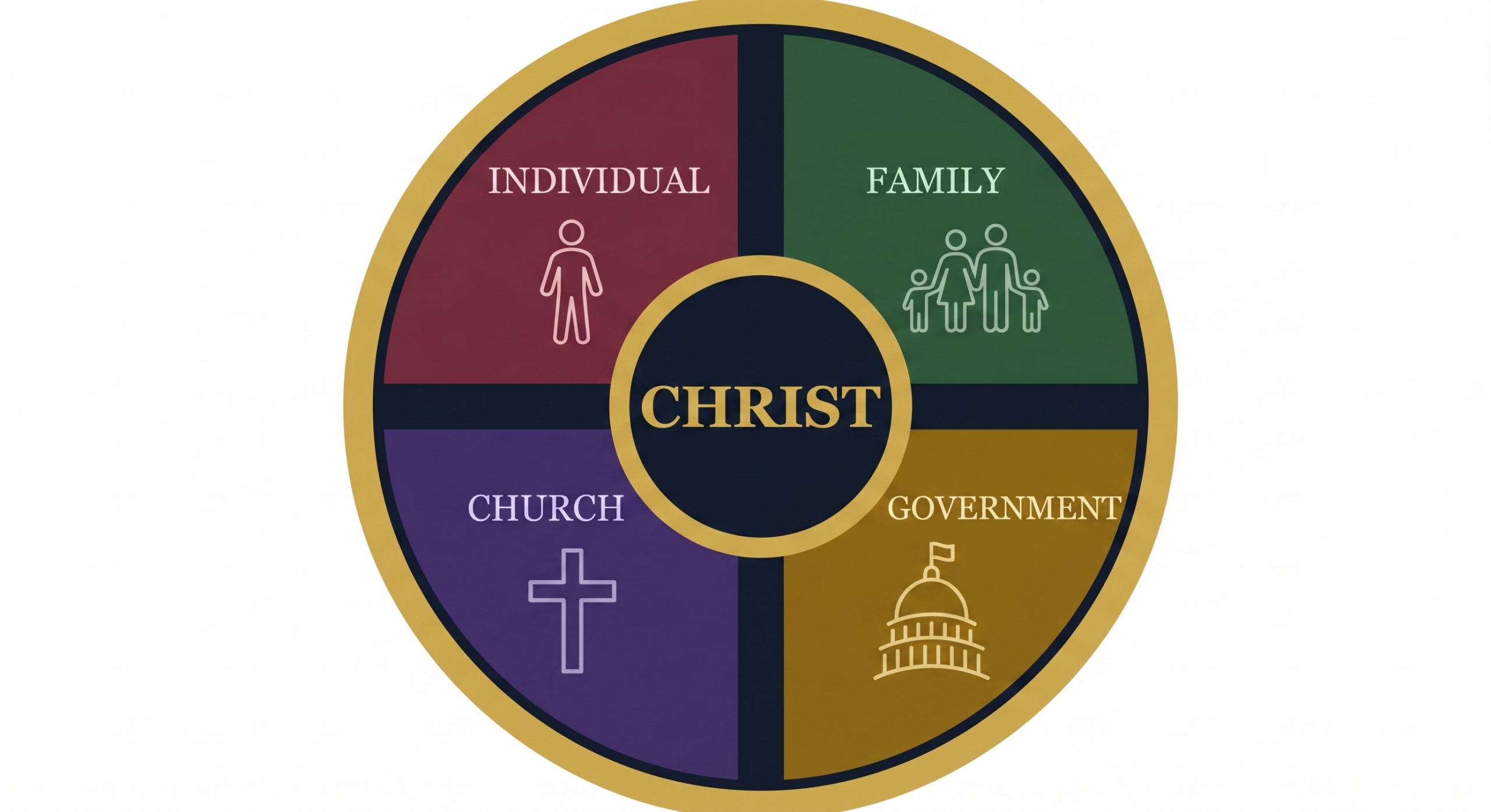
The Four Institutions
God has instituted four spheres of authority, each with its own jurisdiction, responsibilities, and subjects. When each institution functions according to God’s design — and stays within its proper limits — the result is blessing. When one overreaches or fails, the others suffer.
Individual — The Conscience
The individual conscience is the first institution God ordained — the seat of self-government. Every person is created in God’s image and accountable directly to Him. The conscience was given to govern the individual from within: to know right from wrong, to feel the weight of moral obligation, and to respond to God’s law written on the heart.
After the Fall, the conscience was corrupted — suppressing truth, rationalizing sin, losing its calibration. Faith in Christ begins to repair it. A renewed conscience is the foundation of genuine self-government, and self-government is the foundation of every other institution. A people who cannot govern themselves will be governed by others.
Family — The First Community
The family is the second institution God ordained — and the first community. Before there was a church or a state, there was a marriage. God designed the family as the primary environment for discipleship, economic stewardship, and the raising of children to know and fear the Lord.
The family operates under God-ordained headship: Christ is the head of the husband as the husband is the head of the wife — not as a hierarchy of worth, but as a structure of love and delegated authority. A family that understands this doesn’t merely function better — it images the relationship between Christ and His church. The health of a culture is inseparable from the health of its families.
Church — God’s Ambassador
The church is the third institution God ordained — and in one sense the most strategic, because the church is the only institution with a mission that touches all the others. As temple, the church worships God in purity. As flock, the church ministers to its members. As ambassador, the church speaks truth to the conscience, strengthens the family, and holds civil government accountable to God’s moral law.
John the Baptist was beheaded for telling Herod his marriage was unlawful. Peter told the Sanhedrin, “We ought to obey God rather than men.” The church has never been called to silence — it has been called to faithful proclamation in every sphere. A church that retreats from culture does not protect itself. It abandons the institutions God called it to serve.
Government — Instituted for Righteousness
Civil government is the fourth institution God ordained — not as an afterthought, but as a necessary restraint on evil in a fallen world. Romans 13 calls the civil ruler “God’s servant” — a minister of justice, bearing the sword to punish wrongdoers and protect the innocent. Government was never meant to replace the family, control the church, or rule the conscience. It has a defined jurisdiction, and when it stays within it, it is a blessing.
When government exceeds its God-ordained limits — taxing the family into dependence, silencing the church, overriding the conscience — it becomes a curse rather than a blessing. Informed, engaged citizens who understand the Constitution and the religious heritage of our nation are the first line of defense against government overreach. An informed citizen is a free citizen.
How I Teach This
This framework isn’t abstract theology — it’s a curriculum I’ve been developing and teaching for years, in the pulpit, in the classroom, and in civic life. Here’s where you’ll find it:
- Preaching at Memorial Baptist Church — Parkston, SD. Sunday sermons work through biblical texts with an eye toward how God’s Word applies to all four institutions.
- The “Instituted for Righteousness” series — A multi-part curriculum covering each institution: conscience, family, church, and government. Teaching notes and fill-in-the-blank guides available.
- Constitution classes through JBS — Blueprint for Liberty (spring) and Constitution Is the Solution (fall), both seven-week courses held via Zoom, open nationally. Monthly New Member Orientation and the Practical Steps to Restoring American Freedom Where You Live webinar.
- Thompson Chain Reference Bible Workshops — Training pastors and laypeople in systematic Bible study, a tool for building the individual and church institutions.
- South Dakota Right to Life — Board member, advocating for the family and individual institutions at the intersection of conscience and civil law.
Start Here
Not sure where to begin? Here are three good entry points depending on what you’re looking for:
If you’re a Christian wondering why any of this matters
Start with Individual & Conscience — specifically the series on conscience, self-government, and what Scripture says about the responsibility of the individual before God.
If you’re concerned about the direction of our country
Start with Civil Government — and consider joining one of the Constitution classes through JBS. An informed citizen is the first line of defense.
If you want to connect or get involved
Reach out directly — whether you’re local to Parkston, a South Dakotan looking to get civically engaged, or someone across the country interested in Constitution classes.